 Italiano

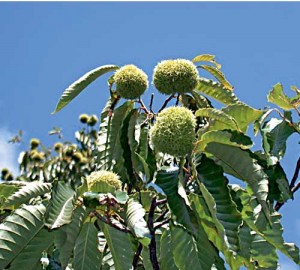
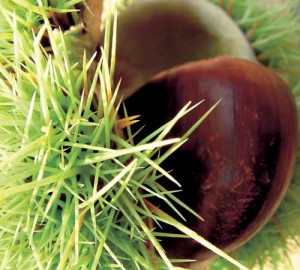 China is the world’s largest producer of chestnuts. China’s original chestnut tree is the Castanea mollissima, a tree producing high quality fruit that is distinguishable for its velvety young branches and very soft leaves – hence the word ‘mollissima’ in the name, meaning ‘very soft’ in Latin. It grows in a number of Chinese provinces from north to south, and has been used historically throughout the country. Today, the Chinese consume 40% of global chestnut production, usually roasted, boiled or added to soups. China is also a major exporter of chestnuts, to nearby Asian nations and also to Europe. Increasingly larger quantities of Chinese chestnuts are also reaching Italian shores. Unfortunately, however, they also appear to be bringing with them an unwelcome insect (oriental chestnut gall wasp), which is now threatening the survival of our own chestnut forests. Sifting through the countless documents from China’s millennia-old history, it would appear that the first written record of the chestnut dates back to the Tang dynasty (618-907), when the fruit was used as an Imperial tribute. During the Liao dynasty (916-1125), a special department of government was established in Beijing solely to control chestnut production. Chestnuts are still considered to bring good luck and in the city of Hongan, for example, in the Hubei province (in northeast China), local chestnuts are roasted and offered to important guests. The Huairou chestnut (怀柔栗子), which is typical to the area around Beijing, has a long history and is renowned for its excellent quality. Near the Huanghuacheng section of the Great Wall is a protected national park, where one can see the largest and oldest forest of this species in northern China. The trees here were planted during the Ming dynasty (1368-1644), and still today, the beautiful yellow blossoms are a spectacular sight in spring. Huairou is now known as the ‘chestnut district’ and to celebrate the harvest of what is known here as the queen among fruit and promote its commercialisation, an international festival is held every September, with entire banquets and cooking competitions based on the chestnut. In the Beijing area, chestnuts are usually roasted, and it is said that they were first cooked this way during the northern Song dynasty (960-1127). Legend has it that two famous experts in the art of roasting chestnuts from Kaifeng (the Imperial capital at the time) fled the city when it was invaded by the Jin people, and moved to Beijing. Here, they offered twenty sacks of roast chestnuts to the visiting ambassador of the southern Song dynasty (1127-1279), as testimony to their homesickness for Kaifeng. Since then, after the yearly harvest, the streets of Beijing fill up with roast chestnut vendors, continuously stirring their chestnuts with a large paddle (once purely manual, but now increasingly replaced by an electric implement) in great woks over an open flame. Sand is added to the chestnuts, which turns black when the nuts are ready, as well as sugar, which makes them sweeter and glossier. Especially in winter, when temperatures in the city plummet, roast chestnuts are particularly popular, because they warm you up as well as providing the body with precious proteins and sugar. More than once, I myself have had the pleasure of strolling through the streets of Beijing while holding a stea
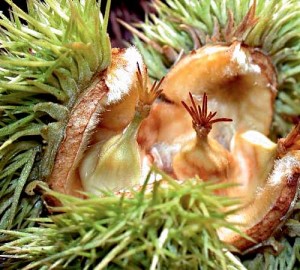 ming hot parcel of delicious roast chestnuts! Chestnuts are also consumed as a snack in China, boiled and sweetened with just a little sugar, and are just as popular as favourites such as pumpkin or sunflower seeds. Little packets of these treats are often sold in airports and train stations in China, and it is a common sight to see passengers whiling away the time with this delicacy. Chestnuts are also highly valued in China because they have always been used in traditional medicine. Chestnuts are recommended to fortify the body and heal the kidneys, while cooked together with blackberries, they aid liver function. It also seems that eating raw chestnuts – in moderation, because they are difficult to digest – fortifies the back and knees. A writer from the Song era, Su Che (1039-1112), was also of this opinion, and wrote a poem in praise of the chestnut and extolling its therapeutic virtues. Vegetarian Buddhist cooking also uses chestnuts as one of the main ingredients for the porridge offered to pilgrims and tourists visiting temples. In ancient times, this was knows as “Porridge of good fortune and virtue” or “Porridge of good fortune and longevity” because, as it is highly nutritious, it helped prolong life and improve the health. The famous queen mother Cixi of the Qing dynasty (1644-1911) used to eat steamed bread made of chestnuts, precisely because she believed it would lead to a longer life.
The history and culinary traditions of the hazelnut in China tell a completely different story. While it has been known since antiquity in China (apparently cited as one of the “five sacred foods” in a manuscript almost 5000 years old), the hazelnut is used today almost exclusively in sweet preparations. In the 1970s, the first experiments with seeds imported from Europe began in the Liaoning province, and further testing was conducted in the 1980s and 1990s with new varieties from Italy and the US, in different climate zones throughout China. The best results were achieved with the trees planted in temperate areas at the coast or in the south of the country. Even today, domestic consumption still depends on imports from the US and Europe, but there are good prospects for an increase in national production, as the country boasts many climatic zones suitable for growing hazelnuts.
Here then, is a typical Chinese recipe, where chestnuts perfectly accompany chicken.
Braised chicken with chestnuts
Ingredients: 450 g chicken; 300 g chestnuts; 2 spring onions; 4 slices of ginger; 2 tablespoons wine for cooking (the original recipe uses Shaoxing rice wine); 2 tablespoons oil.
For the sauce: 4 tablespoons soy sauce; half a tablespoon sugar; half a tablespoon salt; 200 ml water.
Rinse the chicken, dry and cut into medium sized pieces. Chop the spring onion finely. Shell the chestnuts, boil for 3 minutes then remove the skin. Heat 2 tablespoons oil in the wok, add the ginger, chopped spring onion and, lastly, the wine. Add the chicken and sautee on a high heat for a few minutes until golden brown. Add the sauce (prepared previously mixing the ingredients listed above) and lower the heat to a simmer. When the chicken is half cooked, add the chestnuts and continue cooking. Continue braising the chicken on a low heat until the sauce is almost completely absorbed. Serve piping hot.


